Most grill owners use a thermometer for one thing: checking the internal temperature of meat. And while that’s essential, it’s only half the story.
To truly master grilling — especially on pellet, charcoal, or offset smokers — you need to understand the heat around the meat, not just inside it.
That means monitoring:
-
Grill surface temperature
-
Ambient heat inside the grill
-
Consistency of your smoker setup
Going “beyond meat” is what separates a good backyard cook from someone who produces competition-level barbecue.
In this guide, you’ll learn why these external temperatures matter, which tools to use, and how to read them like a pro.
🔥 Why Meat Isn’t the Only Thing You Need to Measure
Perfect BBQ is all about controlled heat, not random flames or guessing.
Internal meat temp tells you when it’s done, but surface and ambient temps tell you how it’s cooking.
Here’s why it matters:
-
Your grill grate can be 75–150°F hotter or colder than the temp shown on your grill display.
-
Heat zones inside your smoker affect how evenly meat cooks.
-
Surface temperature determines searing quality.
-
Accurate ambient temp ensures clean smoke and steady airflow.
-
Knowing your heat levels prevents overcooking or temperature stalls.
When you control the heat environment, you control the final result.
🥩 1. Grill Surface Temperature — The Secret to Perfect Searing
Your grill grates — not the air — are what actually touch your steak, chops, or burgers.
So surface temperature is critical, especially for:
-
Steak searing
-
Smash burgers
-
Chicken breasts
-
Fish fillets
-
Vegetables
🎯 Ideal Surface Temps:
-
Searing steak: 450–650°F
-
Burgers: 400–500°F
-
Chicken: 350–450°F
-
Vegetables: 350–425°F
But your pellet grill or smoker may read 300°F while the grate is actually 475°F (or the opposite).
🛠 Best Tool: Infrared (IR) Thermometer
An IR thermometer lets you instantly scan the grates to:
-
Identify hot spots
-
Check if your grill is ready for searing
-
Ensure consistent heat after opening the lid
-
Monitor temperature recovery
This tool gives you total surface control — something a built-in thermometer can never do.
🌡️ 2. Ambient Heat — Understanding the Real Cooking Environment
Ambient temperature refers to the air temperature inside the grill or smoker.
This is different from the grill controller on pellet grills or the dome thermometer on charcoal grills.
Why ambient heat matters:
-
It controls how fast or slow your meat cooks
-
Helps manage long cooks like brisket or pork shoulder
-
Detects dips caused by wind, cold weather, or lid openings
-
Keeps smoke clean, avoiding bitter flavors
🛠 Best Tool: Leave-In Ambient Probe
Most dual-probe thermometers include one probe specifically for ambient air.
Place it:
-
Near the meat
-
A few inches above the grate
-
Away from direct flame or metal contact
This gives you the true cooking temperature — not the exaggerated dome reading.
🚬 3. Smoker Setup — Using Thermometers to Dial In Clean Smoke
Whether you use a pellet grill, offset smoker, or charcoal setup, thermometers help ensure your smoke is:
-
Clean
-
Thin
-
Blueish
-
Not thick or dirty
Dirty smoke comes from unstable temps, smoldering pellets, bad airflow, or dips/spikes in heat.
What to track:
-
Firebox temp (for offsets)
-
Chamber ambient temp
-
Smoke stack temp
-
Meat probe temp
This “heat map” lets you understand your smoker like a professional pitmaster.
🔧 4. The Thermometer Types You Need for Full Control
You don’t need 10 gadgets — just three reliable tools:
✔ 1. Instant-Read Thermometer
For checking doneness or confirming meat temps.
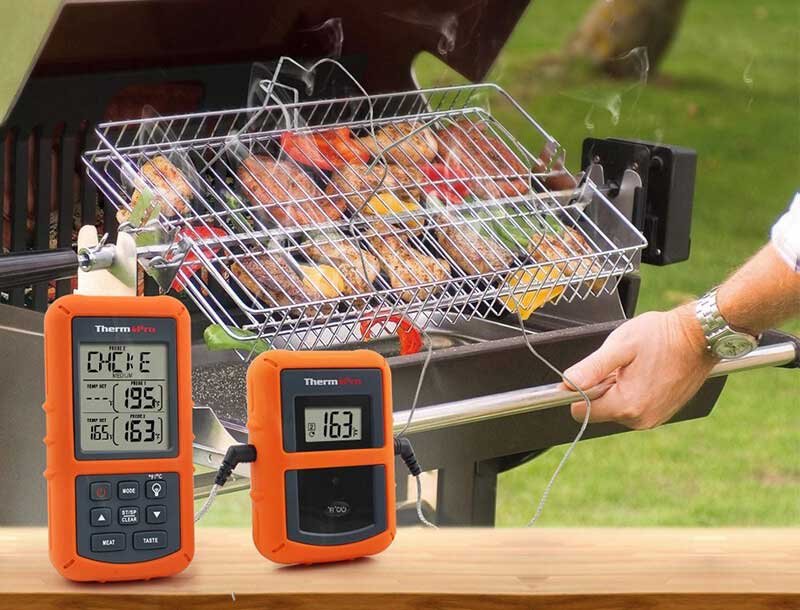
✔ 2. Dual-Probe Wireless Thermometer
One probe for meat + one for ambient heat.
Perfect for long cooks.
✔ 3. Infrared Thermometer
For surface temps, hot-spot checks, and searing accuracy.
With these three, you understand every layer of heat inside your grill.
📊 5. How to Use All Three Thermometers Together
Imagine you're cooking a reverse-sear ribeye:
Step-by-step:
-
Use ambient probe to maintain 225–250°F during the slow-smoke.
-
Use meat probe to track internal temp (pull at 120–125°F).
-
Heat your searing area.
-
Use IR thermometer to check if the grate is above 525°F.
-
Sear each side 1–2 minutes.
-
Finish with instant-read thermometer for perfect accuracy.
This is the exact workflow used by competitive BBQ teams.
🍖 6. Why “Beyond Meat” Makes You a Better Cook
When you monitor all temperatures — not just meat — you get:
-
Better smoke flavor
-
Perfect bark formation
-
Consistent cooks
-
Better searing
-
Fewer temperature swings
-
Predictable results every time
You stop guessing.
You start cooking with confidence.
And your BBQ becomes noticeably better.
🔥 Final Thoughts: Temperature Control Is Everything
Great barbecue isn’t about luck — it’s about precision.
Using thermometers for grill surface, ambient heat, and smoker setup gives you complete mastery over your cooking environment.
Once you go beyond meat, your grilling improves instantly — juicier steaks, better-smoked brisket, and more consistent results on every cook.